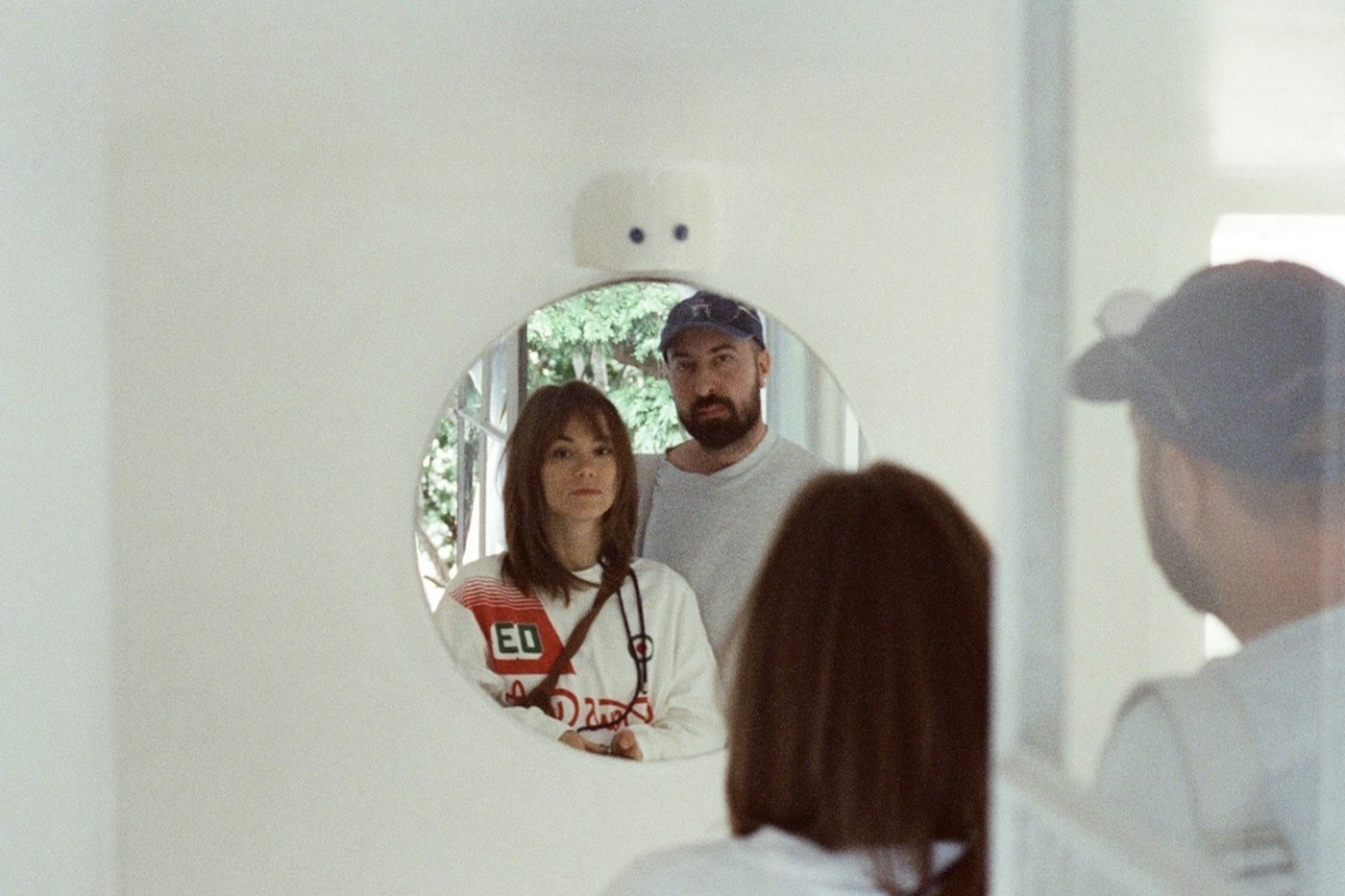
Does a mirror really swap left and right?
In a vertical plane mirror, the geometric transformation reverses the direction perpendicular to its surface: depth, or front and back. There is no special rule choosing to swap left and right while sparing top and bottom. The head remains above the feet because the height of the image points is maintained. The impression of a sideways swap arises when we interpret the reflection as another person facing us.
An experiment with three directions
Facing a mirror, first point at the ceiling. The reflection also points at the ceiling. Point at a side wall of the room: the image points at that same wall. Finally, point towards the mirror’s surface. The apparent direction of the reflected finger comes the opposite way, towards you. This small test, explored by the Exploratorium, distinguishes the room’s axes from the names we give to an imagined person’s hands inside the mirror.
Why does the other person seem to raise the wrong hand?
When two people face each other, one person’s right hand is on the opposite side from the other’s right hand. We make that comparison almost without thinking. But the reflection did not walk to the other side or rotate its body to face us. It is an image produced by reflection. Confusing it with a person who has turned around creates an expectation that the anatomical sides should align differently. The mirror keeps points on the room’s right on the same side of the room.
Why do the letters on a T-shirt look reversed?
An asymmetric letter makes the change of orientation more evident than an approximately symmetrical face. Write a large F on a transparent sheet and look at it from each side. The shape already looks different depending on the side you view. When showing a word to a mirror, how you turned its support also matters: rotating it sideways is not the same action as turning it over from the top. Comparison requires a fixed viewpoint rather than attributing a preference for words to the mirror.
Where does the image that seems behind the glass form?
Light reflects from the surface and reaches the eyes. We interpret the rays as coming from points behind the mirror, forming a virtual image: the light need not pass through to a hidden second room. In an ideal plane mirror, the image appears the same distance behind the surface as the object stands in front. If you stand one metre from the mirror, the image appears one metre beyond it. It also preserves the object’s geometric size.
Can a mirror show an upside-down image?
The surface’s orientation matters. If a reflecting surface is horizontal, such as a mirror on the floor, the direction perpendicular to it becomes vertical. That is no longer the same case as a vertical bathroom mirror. Curved mirrors can also produce images with different characteristics, depending on curvature and object position. The original question concerns a vertical plane mirror: that setting explains why feet remain below the head.
Frequently asked questions
Can a mirror tell left from right?
No. Reflection depends on surface geometry and light, not the names we give the body’s sides.
Why is my reflection not upside down?
In a vertical plane mirror, height is maintained; the reversed direction is perpendicular to the surface.
Is the image really behind the mirror?
It is a virtual image. Rays reaching your eyes seem to come from there, but do not physically meet at that location.