When did the Berlin Wall fall?
The Berlin Wall opened on the night of 9 November 1989, when pressure from thousands of people led to passage through checkpoints between East and West Berlin. The phrase fall of the Wall refers above all to the collapse of that political barrier and its control over movement. The concrete did not all disappear that night, and Germany was not immediately reunited.
German reunification took place on 3 October 1990, following political decisions and international negotiations. Elections, agreements and institutional changes separated the border opening from the union of the two states. Distinguishing these developments explains a transformation with one highly symbolic night that nevertheless grew out of earlier processes and continued for many months. Construction, opening and reunification belong in the same timeline, but represent different events.
| Date | Event |
|---|---|
| 1949 | Two German states established |
| 13 August 1961 | Construction of the Wall begins |
| 4 November 1989 | Large demonstration in East Berlin |
| 9 November 1989 | Border checkpoints open |
| 12 September 1990 | Two Plus Four Treaty signed |
| 3 October 1990 | German reunification |
Why were there two German states and a divided city?
After Nazi Germany's defeat in 1945, the country came under occupation by the victorious powers. Berlin was divided into sectors too, even though the city lay within the Soviet occupation zone. Growing rivalry between the former allies contributed to the creation of two German states in 1949: the Federal Republic of Germany in the west and the German Democratic Republic in the east.
West Berlin consisted of the city's western sectors and was surrounded by East German territory. A map showing only a line between two halves of Germany therefore cannot explain the Wall. There was a border between the German states, and a separate system isolating West Berlin. The city's unusual position made it a central location for confrontation, negotiation and movement during the Cold War, with consequences extending far beyond local urban planning.
When was the Wall built, and what was its purpose?
Construction began on 13 August 1961, initially through closed crossings and barbed-wire barriers, followed by increasingly fortified structures. The central purpose for East German authorities was to prevent people leaving for the West. The possibility of emigrating through Berlin threatened the regime's economy, legitimacy and political control. Closing that route was a means of controlling its own population.
Official claims that the barrier offered protection against external threats did not adequately describe its everyday function. It was primarily people on the eastern side who could not cross freely. Families, friendships and journeys to work were separated. Construction was not a joint, symmetrical decision by residents on both sides. It was imposed by a state that used restrictions on movement as an instrument of power, with direct consequences for ordinary personal choices.
Was the Wall just a concrete structure?
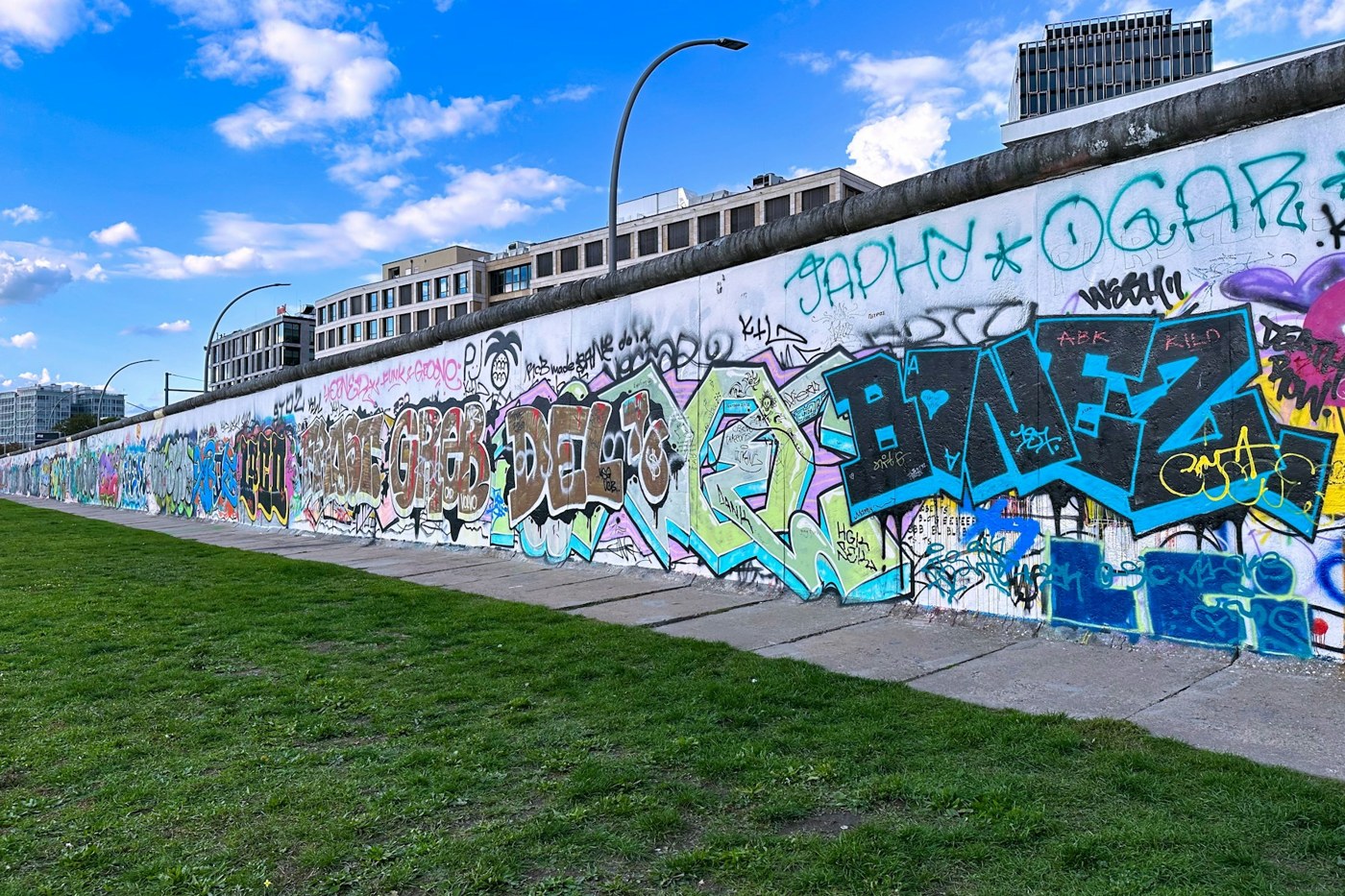
The familiar image shows a concrete surface covered with writing, but the border system included different barriers, surveillance, patrol routes and controlled areas. Its configuration changed over the years. A photograph of one section does not necessarily reveal the full depth or complexity of the installations at that place, much less along the entire boundary surrounding West Berlin.
This distinction helps explain the danger involved in escape attempts. People were not simply climbing an ordinary urban wall. The border regime cost lives and left lasting effects on survivors and families. When looking at a historical photograph, ask which side it was taken from and what remains outside the frame. Physical obstacles and political surveillance reinforced one another, restricting choices that can seem unremarkable today. Understanding the whole system gives the surviving concrete its historical meaning.
How did the protests of 1989 weaken the regime?
The opening did not arise solely from an unexpected statement at a press conference. Throughout 1989, opposition movements and ordinary citizens challenged repression, restricted freedoms and the political leadership's legitimacy. Monday demonstrations in Leipzig and protests elsewhere made increasing internal pressure visible. Staying in the country and demanding change provided another form of resistance alongside attempts to leave it.
Participation involved real risks: demonstrators did not know in advance the outcome now described in history books. The demonstration in Berlin on 4 November showed the scale of opposition shortly before the opening. Economic and political difficulties deepened the loss of confidence, but did not replace people's actions. It is misleading to portray the authorities as simply choosing to grant a freedom that nobody had demanded. The pressure came from society as well as events beyond the country's borders.
What roles did Hungary and the Soviet Union play?
Changes elsewhere in the eastern bloc created new possibilities. Developments along Hungary's border with Austria allowed East German citizens to seek alternative routes to the West. Departures and applications to leave made it increasingly difficult to maintain a system intended to control tightly who could travel or move abroad. The Berlin border was becoming less sustainable within a wider regional transformation.
Mikhail Gorbachev's reforms and changes in Soviet policy also influenced the room for manoeuvre available to governments in the region. Recognising this contribution does not mean assigning the end of the Cold War to one individual. International decisions, national developments and citizens' initiatives interacted. The Wall did not lose its practical and political foundations through an isolated event detached from the rest of Europe. External changes and internal pressure worked together, with neither fully explaining the outcome alone.
What did Schabowski announce on 9 November?
During the early evening of 9 November 1989, Günter Schabowski presented new travel rules at a press conference. Asked when they would take effect, he indicated that they applied immediately, although procedures and communication to border posts had not been prepared on that basis. The information was understood and broadcast as an opening of the borders, creating expectations the authorities could not easily contain.
The announcement mattered because it reached a society already mobilised and eager for freedom of movement. A sentence did not possess a magical power to erase institutions. People heard the news, went to checkpoints and demanded to cross. The gap between what the leadership intended to administer and what citizens understood accelerated the collapse of control. Communication became a catalyst in a crisis with deeper causes, rather than the complete explanation for the transformation.
How did the checkpoints open that night?
Thousands gathered at crossings while border officials sought instructions and faced a situation the existing system could not manage. Bornholmer Strasse became a decisive location in the opening. Restrictions gave way, and crossings opened across the city during the night. Movement ceased to depend on the controls that had maintained separation for decades, producing an extraordinary change in everyday possibilities.
Pictures of embraces, crowds and people standing on the Wall capture the symbolic power of that moment. They should not erase the distinction between celebration and complete legal transformation. The East German state and many of its institutions still existed. The night changed the situation fundamentally, but did not instantly resolve government, property, employment, currency or international relations. Those questions required further decisions during the following year, beyond the dramatic images that came to represent the entire process.
What happened between the opening and reunification?
During 1990, the process moved from freedom of movement to political reorganisation and negotiations over German unity. Democratic participation and decisions by elected representatives were essential in determining the course. Reunification also had an international dimension, because the four powers' rights and responsibilities concerning Germany and Berlin had not disappeared simply because checkpoints opened. Both domestic choices and external arrangements mattered.
The Two Plus Four Treaty, signed on 12 September 1990 by the two German states and the United States, Soviet Union, United Kingdom and France, established the external framework. On 3 October, East Germany acceded to the Federal Republic, making unification a reality at state level. This explains why the celebration in November 1989 and German Unity Day belong to the same history while marking different dates and different kinds of change.
Did the Wall's fall end the Cold War?
The opening became one of the most powerful symbols of the end of Europe's division. But the Cold War involved much more than a concrete border in Berlin: military alliances, ideological competition, nuclear weapons, regional conflicts and relations between major powers. Its conclusion was a wider process that cannot fit into one evening or the biography of one leader. A symbol can stand for a transformation without containing all its causes.
It is also important not to confuse the Wall's opening with the Soviet Union's dissolution, which occurred in 1991. The changes of 1989, reunification in 1990 and Soviet developments in 1991 were connected but distinct. That sequence reveals both the speed of change and the negotiations and uncertainty between milestones. The memorable image helps people recall events; the wider context helps explain them.
What remains, and how is the history preserved?
Much of the border infrastructure was dismantled after the opening, particularly in the period that followed. Some sections and sites were preserved to document division and its consequences. The Berlin Wall Memorial at Bernauer Strasse helps explain elements of the border system. The East Side Gallery preserves a section associated with artworks created after the opening, offering a different perspective on the surviving structure.
Not every remnant serves the same purpose or represents the same viewpoint. A painted wall, a line marked in paving and a memorial site communicate different kinds of information. Reading the interpretation and distinguishing original structures, reconstructions and later artwork makes a visit more informative. Preserving memory means recognising both the actions of people seeking freedom and the suffering caused by separation, without reducing decades of history to a single celebratory photograph.
Frequently asked questions
On what date did the Berlin Wall fall?
The border opened on the night of 9 November 1989. The phrase refers primarily to the collapse of restrictions, not the immediate removal of all the concrete.
When did construction begin?
On 13 August 1961, with closed crossings and initial barriers that were subsequently reinforced and transformed.
Who built the Wall, and why?
East German authorities imposed the barrier primarily to prevent citizens leaving for the West and to maintain the regime's control.
Did the Wall fall on the day Germany was reunited?
No. The Wall opened on 9 November 1989; German reunification took place on 3 October 1990.
Why did West Berlin have its own surrounding border?
Its western sectors were surrounded by East German territory. The city's geography differed from the general border between the two German states.
Did one press-conference sentence bring down the Wall?
The announcement precipitated the opening, but occurred amid protests, mass departures and a crisis of the regime. Citizens' pressure at checkpoints was decisive.
Can visitors still see the Berlin Wall?
Yes. Preserved sections and memorial sites include Bernauer Strasse and the East Side Gallery, which present different aspects of the history.