How tall was Napoleon Bonaparte?
Fondation Napoléon gives a recorded measurement of five French feet, two inches and three lines, corresponding to around 1.69 metres. That does not describe an unusually short man for his time. Conversion precision should not be confused with a modern millimetre-accurate measurement. To answer the popular question, the essential task is comparing equivalent units and considering the population of the period rather than transporting the number directly to today’s standards.
Why do five feet and two inches create confusion?
Old French units were not exactly the same length as English ones. Reading the French entry as a British measurement produces a shorter height and fuels the idea of a very small Napoleon. The problem resembles comparing temperatures without noticing Celsius or Fahrenheit: the number alone is insufficient. Before converting, identify the system used in the document. The same written expression can conceal different physical measurements.
How did British caricature help establish the image?
James Gillray popularised “Little Boney” from 1803 onwards. His caricatures portrayed Napoleon as tiny, agitated and theatrical. The National Portrait Gallery explains that Gillray never observed him in person and relied on French engravings. Political drawing sought to ridicule an opponent rather than provide an anthropometric portrait. Repetition of that visual convention can make a satirical character seem like a documented physical description.
Did tall soldiers also affect perceptions?
Fondation Napoléon notes that the grenadiers surrounding him could be selected for above-average height. Someone of ordinary height looks smaller among particularly tall men. It is a visual comparison without any change to his real size. The example explains why photographs, paintings and accounts of public appearances need context. Apparent height within a group is not a ruler, especially when the composition was chosen for effect.
What does Jacques-Louis David’s portrait teach us?
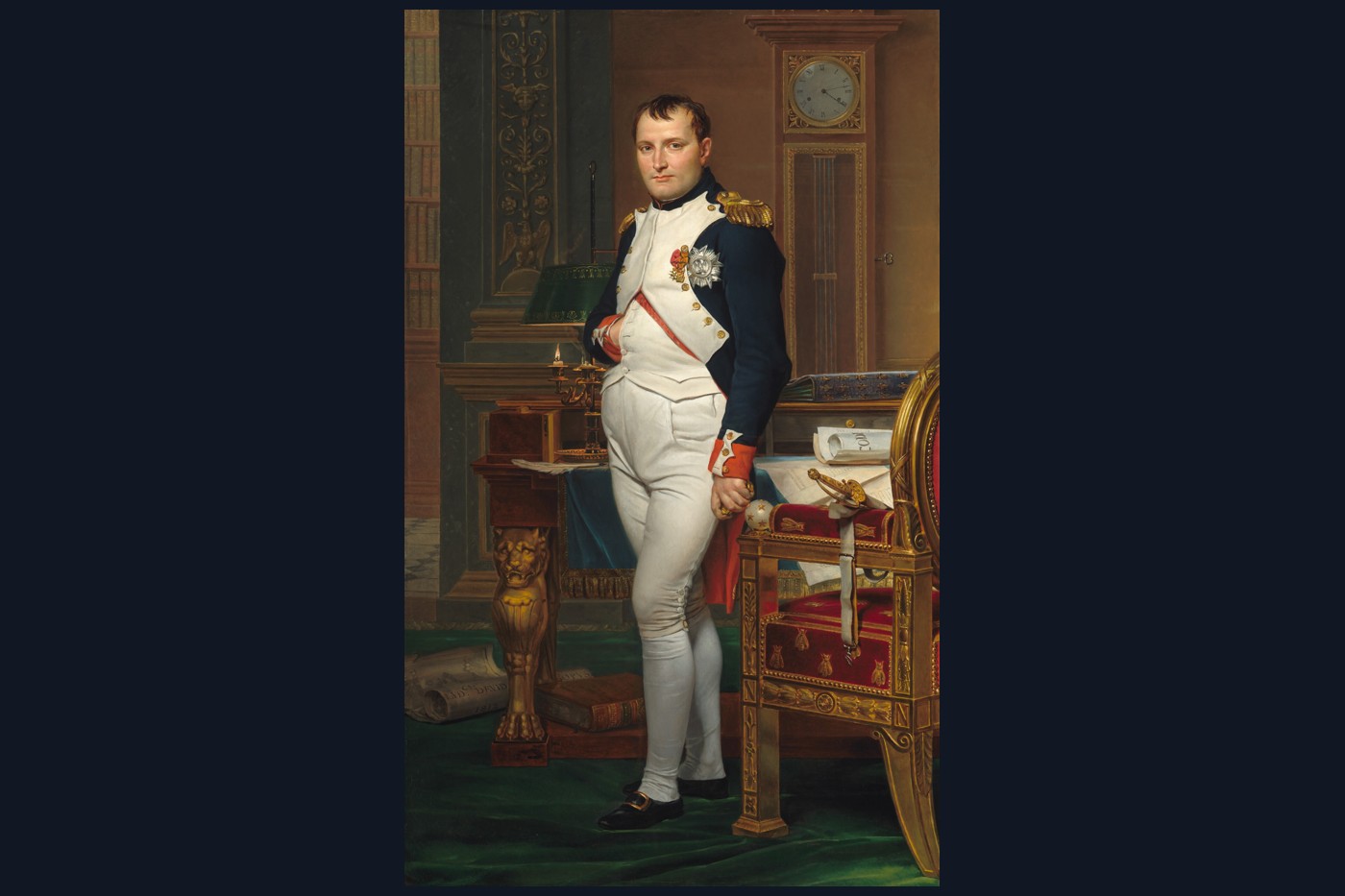
In the 1812 painting held by the National Gallery of Art, Napoleon appears in his Tuileries study among papers and working furniture. The clock and nearly spent candle construct an image of a ruler dedicated into the early hours. The painting also communicates a political message, though very different from British caricature. It cannot measure the emperor. It shows how representational details guide what viewers think about the person portrayed.
Why is the myth still so convincing?
It is a short, repeatable story associated with memorable images. A conversion error combines with a satirical tradition and the explanation seems to confirm what people have seen drawn. Separating the evidence takes more steps: identify the unit, compare context and ask why an image was created. None of this turns height into a judgement on his career. It simply replaces a physical stereotype with a more rigorous reading of historical sources.
Frequently asked questions
Was Napoleon around 1.57 metres tall?
That figure often comes from reading the French measurement in English units. Fondation Napoléon’s conversion is close to 1.69 metres.
Did Gillray meet Napoleon in person?
According to the National Portrait Gallery, no. He based his depictions on French engravings.
Can a painted portrait confirm height?
Not by itself. Composition, perspective and political intent prevent using it as a direct physical measurement.