Who built the pyramids of Giza?
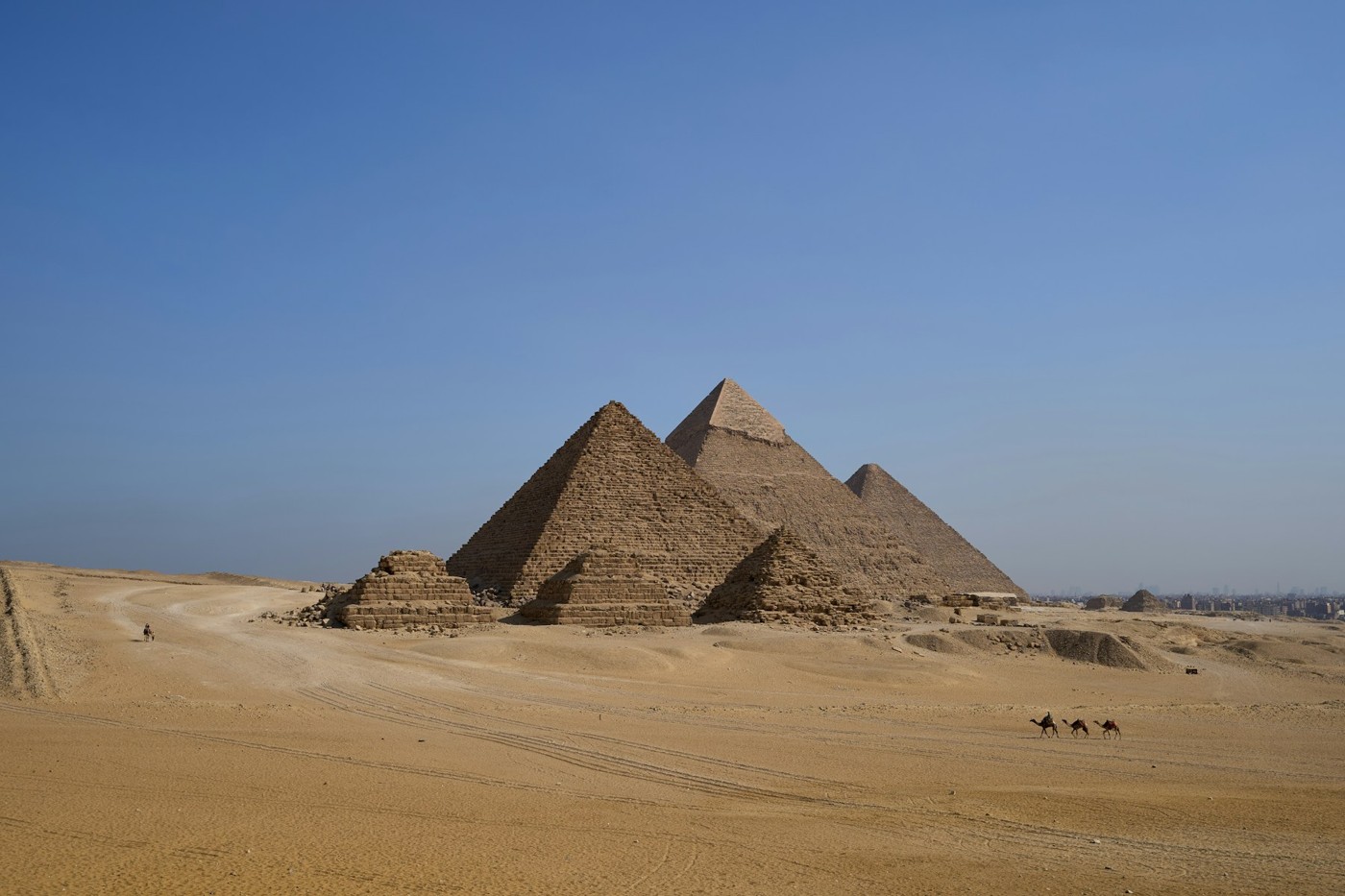
The three great Giza pyramids were built in Ancient Egypt for the kings Khufu, Khafre and Menkaure during the Fourth Dynasty. They were not a single construction project or the work of one generation. They belonged to funerary complexes with temples, connecting routes and other spaces. Understanding that whole changes the question: besides stacking stone, people had to plan access, house workers, distribute food and sustain enormous organisation for years.
What evidence exists about the workers?
Archaeology has uncovered remains of a settlement and cemeteries associated with construction crews. At Heit el-Ghurab, southeast of the plateau, areas for housing, storage, administration and circulation have been identified. Food remains, including animal and fish bones, help reconstruct life there. The finds allow researchers to study real people and project logistics rather than only finished monuments. Not all the structures, however, belong to exactly the same construction phase.
Were they built only by slaves?
The picture of an undifferentiated mass of slaves does not match the account presented by Harvard’s Digital Giza project. Construction involved an organised workforce with different tasks, including specialists and workers transporting materials. Food provision and forms of remuneration belonged to that period’s economy, rather than equating to a modern cash wage. This does not mean projecting today’s labour relations onto Ancient Egypt; it means the remains do not support the simplified version popularised in many depictions.
How could they move such heavy blocks?
Sledges and ropes are an important part of explanations of overland transport. Experiments by University of Amsterdam physicists showed that the right amount of water makes sand firmer and reduces the force needed to pull a sledge. In dry sand, grains tend to pile up in front of the object; moisture can reduce that obstacle. The finding gives an ancient technique physical plausibility without demonstrating that every block of every pyramid followed exactly the same route.
Why does water appear in ancient depictions?
A painting in Djehutihotep’s tomb shows a large statue on a sledge and a person pouring water ahead of it. Experimental work helps interpret that gesture as a potential technical aid. Chronology must nevertheless be respected: the image is later than the great Giza pyramids. It provides evidence about Egyptian heavy-load transport practices, not a direct picture of Khufu’s construction. Archaeology, images and physics complement each other when each clue’s limits are clear.
Do we know exactly how they raised every stone?
There is still no single agreed reconstruction of every stage in lifting the blocks. Different proposals involving ramps and work organisation seek to answer the problem. A way of moving a load along the ground does not automatically solve placing it at height. What we already know about settlements, crews and transport demonstrates a complex human undertaking. Research continues chiefly into details of execution, rather than requiring abilities outside Egyptian society.
Frequently asked questions
Were all three pyramids built at the same time?
No. They are associated with three successive Fourth Dynasty kings: Khufu, Khafre and Menkaure.
Does wetting sand make any load easy to move?
No. The experiment depends on the appropriate amount of water and sand conditions; it does not eliminate weight or the need for work.
Does the sledge painting show Khufu’s construction?
No. Djehutihotep’s scene is later and depicts transporting a statue. It helps study Egyptian techniques without directly documenting that project.