What is an exoplanet, and why is finding one difficult?
An exoplanet is a planet outside the Solar System. Many of those we study orbit other stars. Distance and contrast make observation challenging: a planet can be hidden in its star’s glare. Finding one therefore does not necessarily mean taking a photograph of a small world with visible continents. Astronomers can investigate effects on the star’s light and motion instead. This is a way of learning about something through the signals it produces. To understand a discovery, first ask what was measured and how that measurement supports the possibility of a planet.
How does the transit method work?
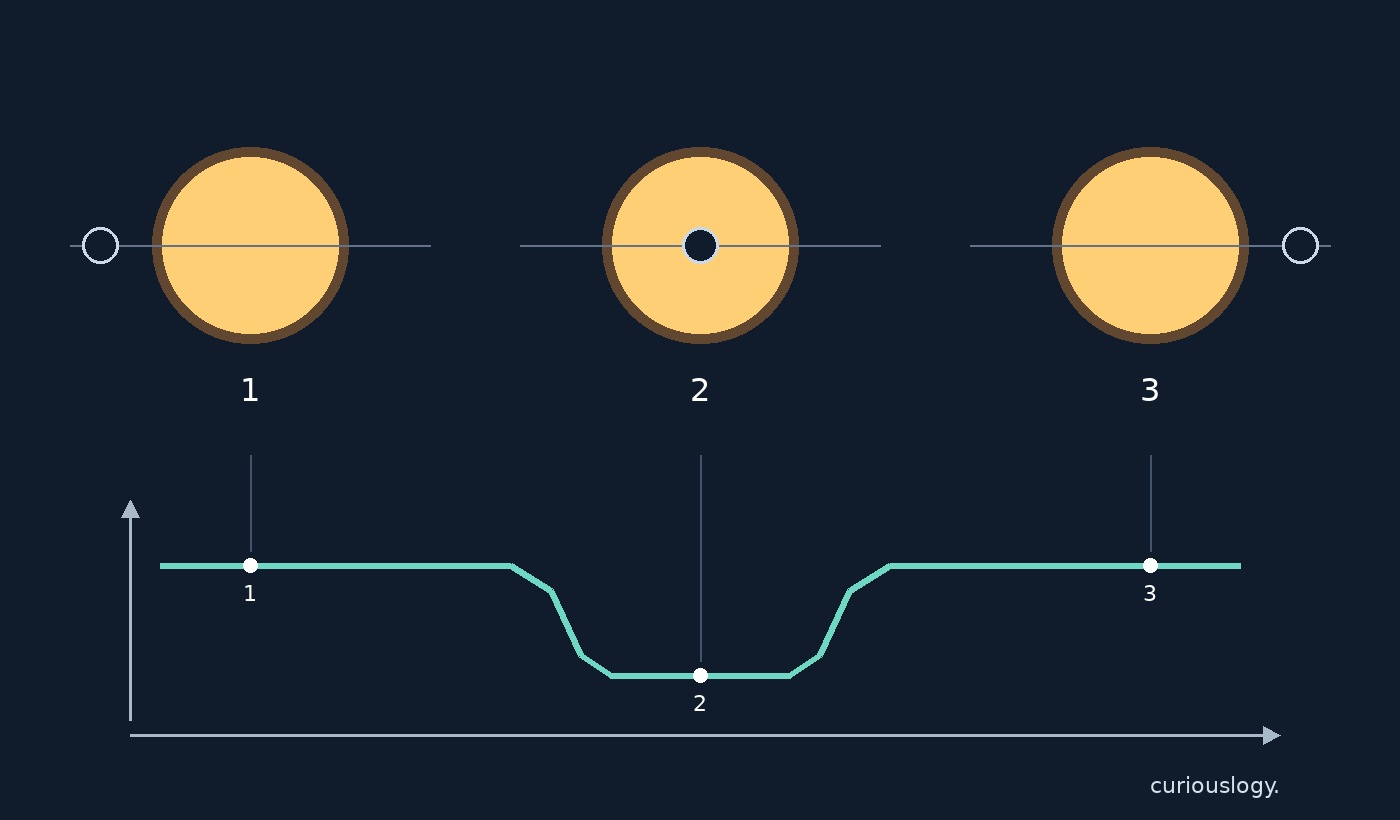
When an orbit is suitably aligned with an observer, a planet can pass in front of its star and block some of the light reaching us. That crossing is a transit. Instruments track brightness over time and look for dips compatible with this situation. Repeated events help investigate the orbital period. Orientation matters: a planet can exist without crossing its star from our viewpoint. Failing to detect a transit therefore does not demonstrate that the star has no planets. The technique has particular observing requirements, so its results must be interpreted within those limits.
How should you read this article’s diagram?
The three panels show a simplified sequence from the observer’s viewpoint. At 1, the planet lies outside the star’s apparent disc. At 2, it appears in front of the disc, blocking some light. At 3, it no longer covers it. In the lower curve, the horizontal axis represents time and the vertical axis represents received light: the level falls during the transit and then returns. Sizes and dip depth are exaggerated to make the explanation clear. The drawing contains no real measurements and cannot be used to calculate the size of a particular exoplanet.
What does radial velocity reveal?
A star and planet exert gravitational pulls on each other. Their interaction can cause stellar motion with a component towards us and then away from us. Radial-velocity measurements look for small shifts in the star’s spectral lines associated with the Doppler effect. This does not mean watching a star visibly change colour with the naked eye. It is an instrumental measurement of a spectrum. It also differs from tracking the star’s position across the sky, which is associated with astrometry. Keeping these ideas separate helps explain what a velocity graph actually represents and what it does not directly show.
Why combine different observations?
Different techniques can provide complementary information and help test an interpretation. Broadly, a transit relates blocked light to the relative sizes of planet and star, while radial velocity provides information about the gravitational effect and constraints on inferred mass. Analysis depends on models and information about the star itself. There is no automatic conversion from one data point into a complete portrait of a world. When reading results, identify the estimated quantities, assumptions and reported uncertainty. A number accompanied by a range is not necessarily a weaker result; that range can be an essential part of describing what was measured.
Does a brightness dip prove a planet exists?
Not on its own. Other stellar configurations, variability and instrumental problems can produce signals that need investigation. A candidate is a promising possibility still under evaluation, rather than automatically an established discovery. Additional observations and analysis help distinguish alternative explanations. Depending on the case, researchers may use other instruments, techniques or statistical validation. This is why following a discovery requires attention to both the status and date of the result. A headline can compress a stage that the underlying study continues to describe cautiously. Look for the evidence rather than assuming every promising signal has the same status.
Can astronomers obtain direct images?
Yes, suitable instruments and techniques can separate a planet’s light from its much brighter star in some systems. That does not mean exoplanets are routinely photographed with the detail of a terrestrial landscape. A scientific image may show a point of light and use colours to represent observed wavelength bands. Many publicity images are artists’ impressions built around limited information. Always read the caption: a photograph, processed observations, simulation and illustration serve different purposes. A convincing illustration does not add measurements that a study never made, however realistic its clouds or surface may appear.
Does finding a planet mean finding life?
No. Detecting a planet and investigating its conditions are separate questions. The term habitable zone refers to a region where certain conditions could allow liquid water on a rocky planet’s surface; it is not a certificate of demonstrated habitability. An orbit or approximate size does not describe an entire atmosphere and surface. When a headline promises a second Earth, check which similarities were measured and which remain unknown. Treat the comparison as a starting point for questions rather than a conclusion about oceans, climate or living organisms. The distinction preserves both scientific care and the interest of the discovery.
What should you ask about the next discovery?
Look for the method used, the distinction between candidate and confirmed or validated result, the announcement’s source and its associated study. Check whether numbers are estimates and whether the image is an artistic representation. Then identify what the observations support and what would require more data. You can keep a short record with these fields and return to it when follow-up results appear. Curiosity becomes more rewarding when it separates observation, interpretation and an open question. The NASA and ESA sources below provide a route to understanding the techniques beyond a headline.
Frequently asked questions
Are all exoplanets found through photographs?
No. Many are identified through effects on stellar light or motion, including transits and radial velocity.
Does a star without transits have no planets?
That conclusion does not follow. An orbit’s orientation may prevent a planet from passing in front of its star from our viewpoint.
Does the diagram’s curve show a real planet?
No. It is an idealised schematic, not to scale, explaining a transit. The dip depth is not a measurement.
Is a candidate the same as a confirmed planet?
No. A candidate needs further evaluation to exclude alternative explanations and establish the planetary interpretation.