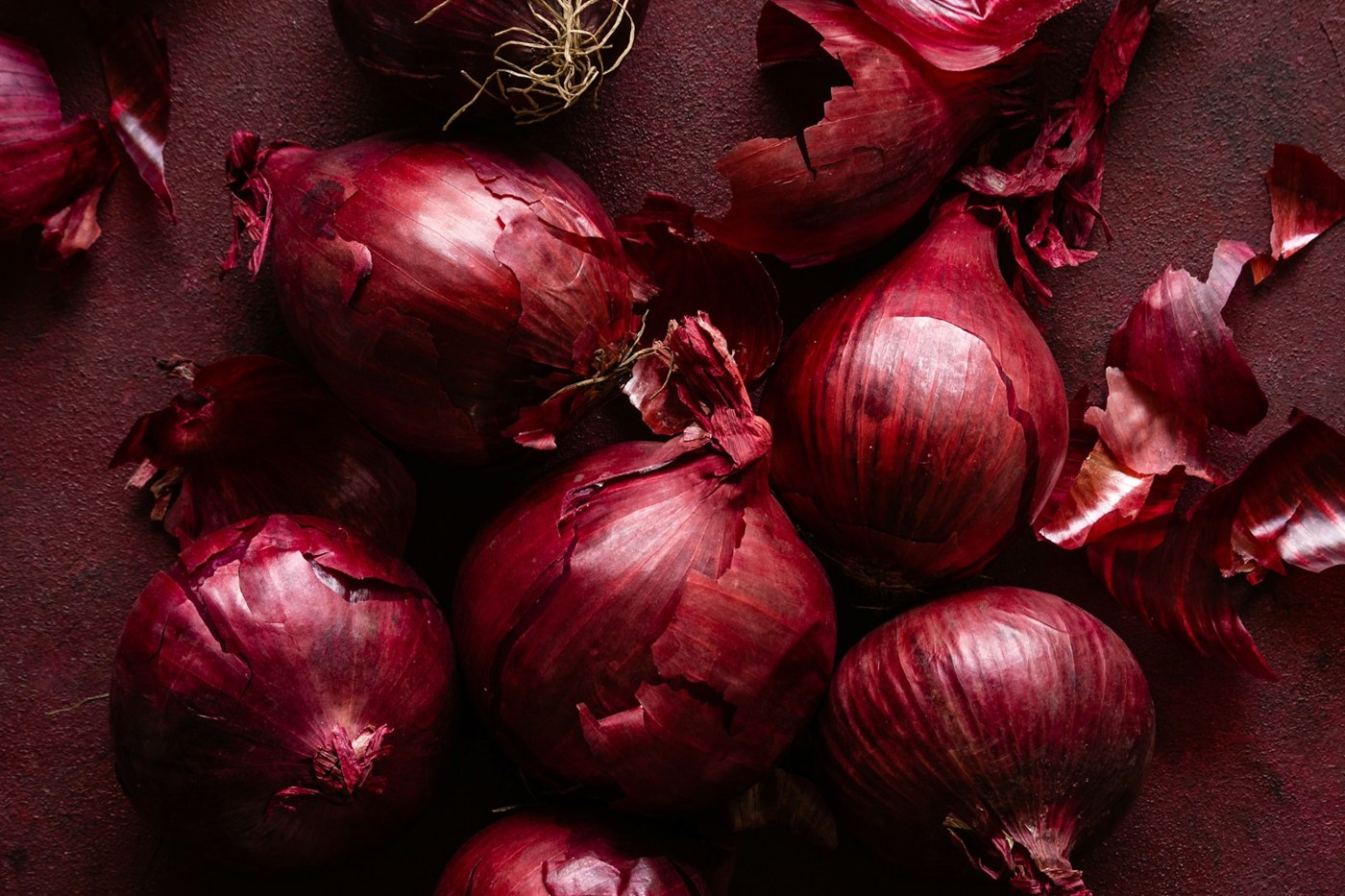
What does an onion release when we cut it?
Tears appear because cutting triggers the production of a volatile substance that irritates the eyes: propanethial-S-oxide, also called the onion’s lachrymatory factor. On reaching the eye’s surface, the compound triggers a protective response. Tear glands produce more fluid, helping dilute and remove the irritant. It is not the smell alone that makes us cry: it is contact with a substance released by the vegetable.
Why does this happen mainly after cutting?
In an intact onion, its components are organised in cells. The blade breaks that tissue and brings together substances and enzymes involved in a sequence of reactions. The enzyme known as lachrymatory-factor synthase helps form the compound responsible for tears. Onion chemistry also involves molecules contributing to aroma and flavour. The effect should therefore not be reduced to the idea that an acidic liquid is waiting to escape from inside.
How does the irritant travel from the board to our eyes?
Alongside the compound’s volatility, cutting itself can throw tiny droplets into the air. Research reported by Cornell University in October 2025 used high-speed cameras to observe the process. The blade’s pressure on onion layers stores energy before the surface breaks; its release projects a mist of droplets. That helps explain why the way we cut affects exposure even without deliberately bringing the onion close to our face.
Does a sharp knife really help?
Cornell’s work points to slow cuts with a sharp blade as a way of reducing droplet projection. A blunt blade tends to compress tissue more before separating it. The conclusion is not that one technique eliminates all tears: variety, quantity, ventilation and individual sensitivity also change the experience. In practice, use a stable chopping board, keep fingers away from the blade and avoid crushing the onion while trying to cut faster.
Why does everyone not cry in the same way?
Watering eyes are a response to contact with an irritant, not a measure of cooking skill. The concentration reaching the eyes and conditions in the room vary. Being very close to the board or cutting several onions can change exposure. There is also no reason to conclude that an onion causing fewer tears has necessarily lost all its flavour. Substances associated with flavour and the tear-provoking effect are related, but are not one and the same thing.
Which popular explanations should we leave behind?
The idea that crying when cutting onions is an emotional response to the smell does not describe the mechanism. It is also simplistic to say that onions contain sulphuric acid that jumps straight into our eyes. The explanation involves damaged plant tissue, enzymatic reactions, an irritant and a tear response. Improving cutting and air circulation is more useful for comfortable cooking than relying on an unproven list of tricks. Avoid touching your eyes with hands used in preparation.
Frequently asked questions
Does cooking an onion have the same effect as cutting it?
The characteristic effect arises when raw tissue is damaged and reactions form the irritant. Preparation and heating change that system, so the situations are not equivalent.
Does a sharp knife completely prevent tears?
No. It may reduce compression and droplet projection during cutting, but does not guarantee the irritant will not reach your eyes.
Is it normal for eyes to water without sadness?
Yes. These are protective reflex tears triggered by the irritant and do not depend on feeling sad.