Read also: Why did Titanic sink? The iceberg, lifeboats and rescue ↗
Read also: Why did the Berlin Wall fall, and when was Germany reunited? ↗
What happened in London in September 1666?
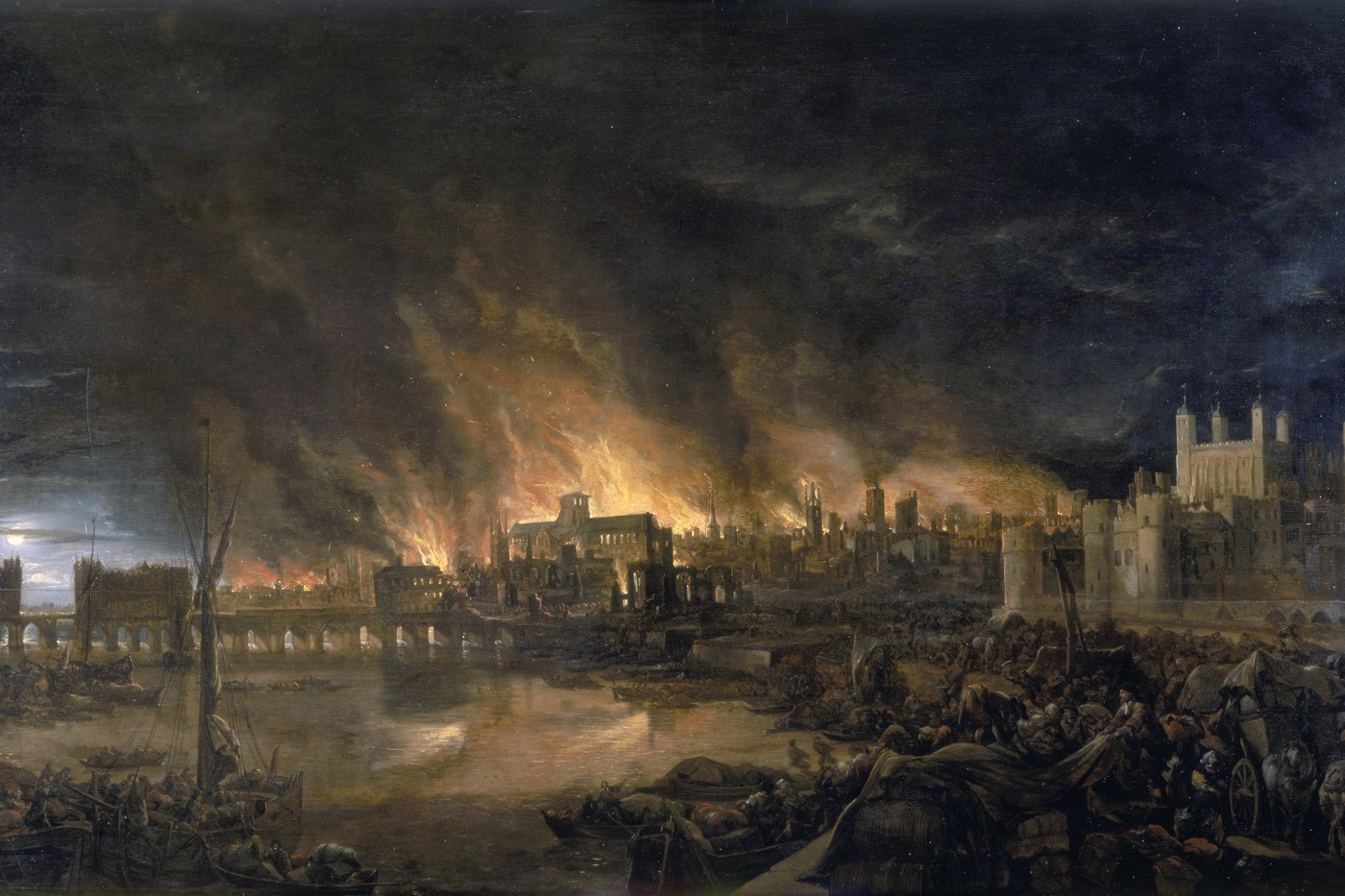
The Great Fire of London began early on 2 September 1666 and destroyed much of the City, the capital's historic commercial centre. The event is usually dated 2–6 September. It did not consume the entire area now called London: districts beyond the central walled area had different experiences. This distinction matters when interpreting maps and estimates of destruction.
Its explanation combines urban conditions, dry weather, wind and limited firefighting capacity. It also shows how disasters generate simplified stories. No single miraculous action saved the city, and the fire did not solve all its health problems. Separating the event from later myths helps us understand both the emergency and the difficult reconstruction. It also makes a dramatic story more informative without making it less compelling.
Pudding Lane bakery and the beginning of the fire
Historical institutions identify Thomas Farriner's bakery in Pudding Lane as the starting point. The London Fire Brigade places the outbreak in the early hours of Sunday. Flames reached the home connected to the business while its occupants were asleep, making escape an immediate priority. The origin is generally regarded as accidental; allegations of deliberate sabotage require evidence beyond contemporary rumours.
A known starting location is different from a perfect reconstruction of every movement inside the bakery. Sources were produced under different circumstances and do not always give precisely the same time. Describing an overnight outbreak is firmer than presenting an exact minute as though a recording existed. This qualification leaves the essential point intact: a local fire encountered conditions that allowed it to become an urban emergency.
Why did the flames spread so quickly?
The London Fire Brigade describes a dry summer, closely packed timber buildings and a strong easterly wind. Buildings stood near enough for fire to move between them, while narrow streets complicated the movement of people and equipment. Warehouses near the Thames stored combustible goods. Being beside a river did not automatically protect the commercial neighbourhoods along its banks.
It helps to distinguish what starts a fire from what sustains its spread. An ignition does not necessarily destroy an entire city. In 1666, the arrangement of buildings, stored materials and weather helped the disaster continue. Its expansion outstripped the equipment and organisation available to contain it. There is no need to imagine every roof covered in thatch to explain why the destruction became so extensive.
Firefighting before the modern fire brigade
London did not have a firefighting organisation comparable to today's professional services. Museums and archives describe a response involving residents, local authorities, buckets, hooks, axes and rudimentary water devices. Bringing water to a burning building was difficult, particularly once several neighbourhoods were threatened and the streets were crowded with people trying to escape.
Hooks could also pull down parts of buildings, creating gaps without fuel. This involved painful decisions about property: destroying an undamaged house might protect many others. Asking whether water was available therefore tells only part of the story. How it reached the fire, at what pressure, along which routes and under whose direction mattered too. Firefighting capacity was a system rather than simply a collection of tools.
A timeline of the four-day emergency
On Sunday, 2 September, the fire spread from Pudding Lane. Attempts to contain it had not brought the situation under control by Monday. The Great Fire of London project's timeline records government intervention and the organisation of firefighting posts. Tuesday, 4 September, brought an especially destructive phase as the emergency reached important parts of the centre.
On Tuesday night and through Wednesday, weaker wind and gaps opened in the built environment helped change the course of events. Most remaining fires were extinguished on Wednesday, although outbreaks appeared around the edges of the affected area. A final isolated fire was contained early on Thursday, 6 September. Consequently, descriptions of a four-day fire and a date range ending on the sixth are not necessarily contradictory: they may describe different stages of containment.
What finally stopped the Great Fire?
The National Archives highlight two complementary factors: easing wind and strategic demolition, including gunpowder used to create firebreaks more quickly. Breaking the continuity between combustible buildings made further spread harder. Once the wind weakened, it became more practical to secure the boundaries of the burned area and put out remaining outbreaks.
This explanation avoids selecting a single hero or miraculous object. Demolition would not necessarily have produced the same result at any moment in any weather. A change in the wind did not remove the need for work on the ground either. The outcome came from the interaction of human intervention and environmental conditions. Understanding that combination is more useful than turning one isolated measure into a universal solution to a complex emergency.
How much was destroyed and how many people died?
London Museum gives approximately 13,200 destroyed houses and around 100,000 people left homeless. Churches, commercial premises and the old St Paul's Cathedral were among the losses. Such figures need to be tied to their geographical area: the City was not the whole metropolis. Percentages presented without that distinction can create a misleading impression of the fire's reach.
The death toll requires particular care. Institutions describe very few recorded deaths, generally fewer than ten, but that does not establish a complete list of victims. It is wrong to turn a limited documentary count into absolute certainty that only six people died. Losing housing, income and possessions was also part of the human impact, even when those losses do not appear in a count of direct deaths.
Do eyewitness accounts tell the whole story?
Diaries, letters, maps, burned objects and official papers provide different kinds of evidence. The National Archives present contemporary documents that readers can compare. A witness might describe events in one street accurately while repeating a rumour about another district. Being close to an event does not make every claim in an account equally reliable.
When reading a testimony, ask when it was written, where its author stood and how they could know what they describe. A later map helps establish the burned area without necessarily following the precise path of every flame. An archaeological object documents a location and material context. Combining these forms of evidence supports a stronger explanation than repeating a dramatic passage without checking where its information came from.
Did the fire end London's plague?
No. London Museum identifies this as one of the most persistent myths. Plague deaths had already been declining before the fire and continued afterwards. Several badly affected districts, including Whitechapel, Clerkenwell and Southwark, were not destroyed by the flames. Two disasters occurring close together does not prove that one eliminated the other.
The story is attractive because it offers a simple positive consequence of a terrible event. Historical explanation, however, requires evidence connecting cause and effect. Burning part of a city does not demonstrate that every mechanism of disease transmission disappeared. The decline and eventual disappearance of major outbreaks cannot be explained merely through an image of rats fleeing a fire. A memorable explanation still needs to fit the geographical and chronological record.
Thatch, bricks and other misleading shortcuts
Another error imagines the City burning because all its roofs were thatched. London Museum notes that thatch had been prohibited centuries earlier. Timber construction, stored materials and the urban layout remain important factors; correcting the thatch myth does not imply that the buildings were invulnerable. It removes one inaccurate detail from a broader explanation.
Brick buildings also existed before 1666. Reconstruction strengthened requirements and changed practices rather than introducing the material to London for the first time. These examples show why introducing a rule, spreading an approach and inventing a technology must be distinguished. A disaster can accelerate change without originating everything that follows. Preserving those distinctions produces clear explanations while avoiding a false picture of how the city developed.
Conspiracy rumours and the search for someone to blame
Accusations against foreigners and Catholics circulated during the emergency. Conflict with other powers helped feed suspicion. London Museum recounts the case of Robert Hubert, executed after confessing to responsibility that did not match the facts; it later emerged that he had not been in London when the fire began. A confession does not remove the need for independent checking.
Here, the existence of an accusation must be distinguished from its truth. A letter reporting supposed sabotage proves that a claim circulated, not that sabotage occurred. Documents therefore reveal fear, prejudice and misinformation as well as the progress of flames. Treating old rumours as newly established facts would reproduce the very mistake we are trying to understand by investigating the past.
How reconstruction left its mark on London
Rebuilding involved housing, commerce, churches, construction rules and practical disputes about land. London Museum connects the period with the development of property insurance. The Monument, completed in 1677, became a landmark of public memory. None of these outcomes means recovery was immediate or experienced equally by everyone who had lost a home or livelihood.
To recognise that legacy, compare three timescales: the disaster over a few days, reorganisation over years and interpretations accumulated over centuries. When visiting London or exploring digital collections, check object dates and captions. An image produced after the fire can represent memory of the event rather than an account drawn at the scene. That distinction turns a historical curiosity into a more attentive way of reading heritage.
Frequently asked questions
When was the Great Fire of London?
It began early on 2 September 1666. The usual date range is 2–6 September, including isolated outbreaks after the main fire had been contained.
Where did the 1666 fire start?
At Thomas Farriner's bakery in Pudding Lane, in the City of London. Its origin is generally regarded as accidental; conspiracy rumours do not establish sabotage.
What put out the Great Fire?
Weaker wind, strategic demolition creating firebreaks and firefighting and containment work combined to stop it. No single measure explains the entire outcome.
Was all of London destroyed?
No. The City was devastated, but the affected area was not the whole of present-day London or every district that existed in 1666.
Did only six people die?
Six is a frequently quoted count of recorded deaths. Surviving records do not justify treating that figure as a certain total of all victims.
Did the fire end the plague?
No. Plague deaths were already declining and continued afterwards, while several badly affected districts lay outside the burned area.
Did London have firefighters in 1666?
It lacked a professional service comparable to today's. Residents and authorities relied on rudimentary equipment and measures such as pulling down buildings.
How can I tell whether a historical image is an eyewitness record?
Check the collection's date, artist and caption. A later painting can depict the fire without having been created by somebody who observed it personally.
Sources and further reading
- London Museum: the Great Fire of London
- London Museum: three myths about the fire
- The National Archives: documents and testimony from 1666
- London Fire Brigade: history of the Great Fire
- The Monument: historical questions about the fire
- London Museum: insurance and rebuilding
- The Great Fire of London: timeline