What keeps an ice cube at the surface?
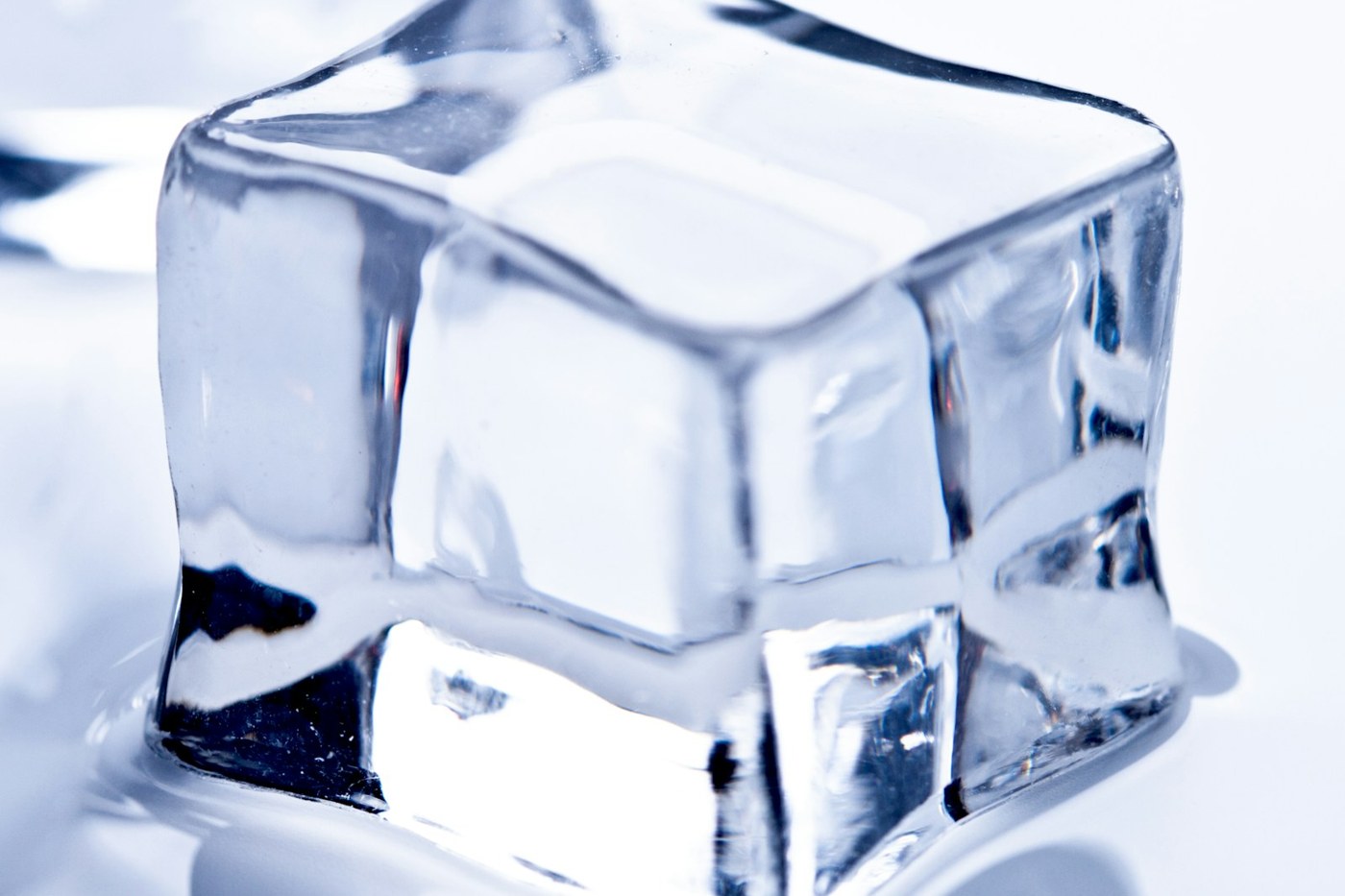
Ordinary ice floats because it is less dense than the surrounding liquid water. Density is the relationship between mass and volume: the same mass may occupy more or less space. When water freezes under usual conditions, its molecules organise into a more open structure. Volume increases without any additional water appearing. Each cubic centimetre of ice therefore contains less mass than the same volume of liquid water.
Why do the molecules spread apart when freezing?
Water molecules attract each other through hydrogen bonds. In the liquid, these bonds continuously form and break as molecules move. In ice, a crystalline network with spaces between molecules becomes stable. The geometry of that arrangement explains its lower density. Water does not need to acquire air bubbles to float: even transparent ice without large bubbles retains the property under normal conditions.
Why is almost the whole cube underwater?
To remain afloat, ice displaces enough water for its weight to balance its own. Because its density is relatively close to the liquid’s, it needs to remain almost entirely submerged. The USGS says ice has approximately nine tenths the density of water. That is why the visible portion of an iceberg is much smaller than the hidden part. The exact proportion varies with factors including salinity, temperature and air trapped in the ice.
Does water always become denser as it cools?
No. Fresh water reaches its maximum density near 4°C. As it cools below that and approaches freezing, it becomes less dense. This feature contributes to winter thermal layering in lakes: colder water can remain near the surface, where ice forms. The intuitive rule that everything shrinks continuously as it cools does not correctly describe this temperature range for water.
Why is this important for life in lakes?
Surface ice creates a barrier that reduces heat loss from the water beneath it. Many lakes retain liquid water under the layer, allowing aquatic organisms to survive winter. That does not mean a lake can never freeze completely: depth and weather conditions matter. But ice forming at the top, rather than first accumulating on the bottom, profoundly changes the environment where fish, plants and other organisms live.
How can we understand the difference between mass and density?
A large ice cube can have more mass than a small stone and still float while the stone sinks. Comparing total weight alone is insufficient: consider the volume each object occupies and the water displaced. Nor should we conclude that ice floats in every liquid. What matters is the comparison between the solid’s density and that of the surrounding fluid. In the usual combination of ordinary ice and water, that comparison favours floating.
Frequently asked questions
Does ice float because it has air inside?
It does not need bubbles to float. Ordinary ice’s crystalline structure already makes it less dense than liquid water.
Is most of an iceberg’s volume underwater?
Yes. Because ice’s density is close to water’s, most of it must remain submerged to balance its weight.
Does ice float in every liquid?
No. Floating depends on the density of ice compared with the liquid it is in.