Cuisine: Portuguese
Ingredients · 4 portions
Preparation: 20 min · Cooking: 30 min · Total time: 50 min
- 500 g peeled potatoes
- 180 g cleaned couve-galega or collard greens
- 120 g onion
- 2 garlic cloves
- 1.2 litres water
- Up to 300 ml extra hot water for adjusting
- 40 ml olive oil
- 4 g salt initially, adjust at the end
- 100 g Portuguese chouriço, optional
What kind of caldo verde are we making?
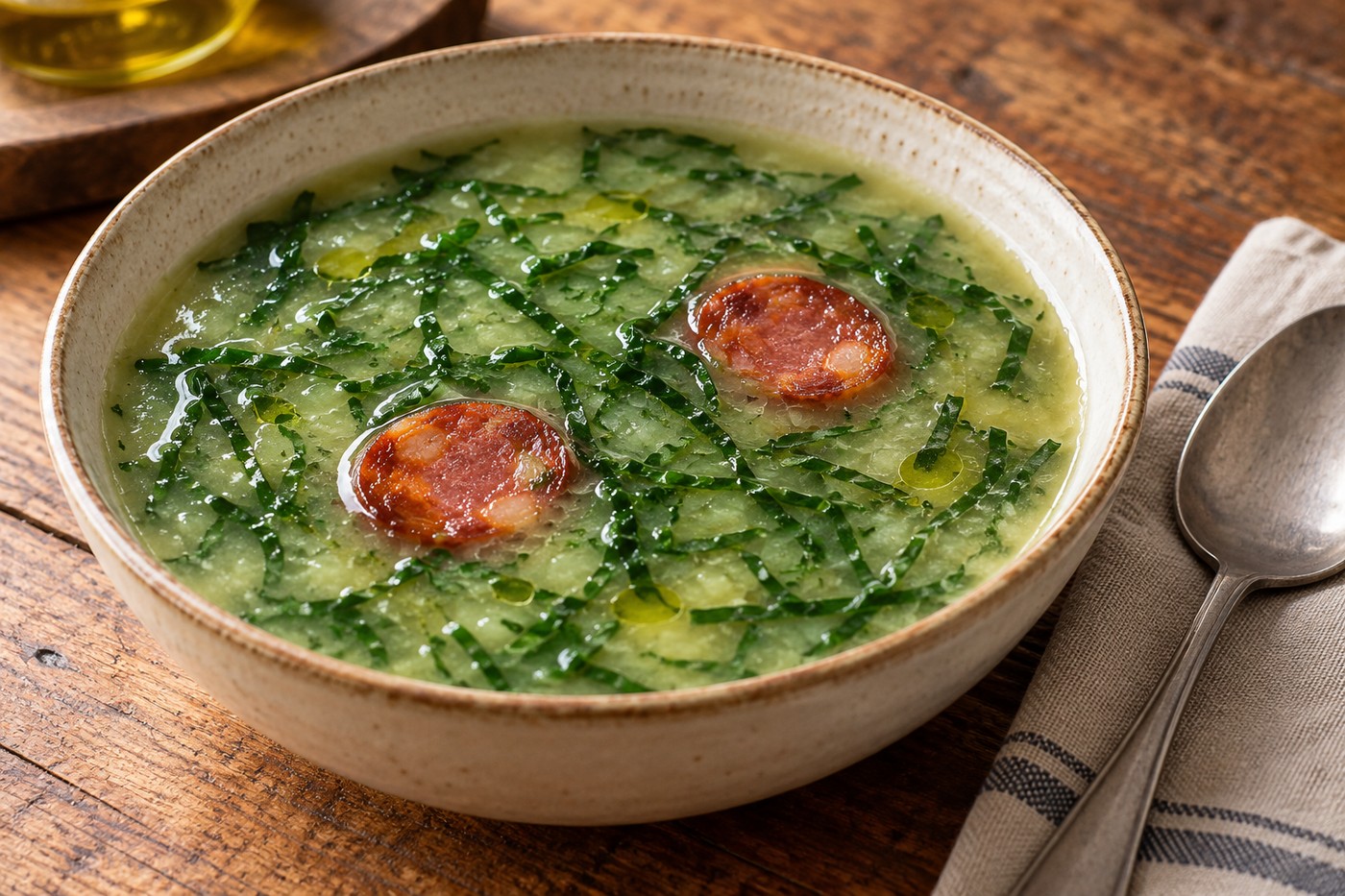
Caldo verde brings together a potato base, very finely sliced greens, garlic, onion and olive oil. This version makes four soup portions and takes about 50 minutes: 20 minutes of preparation and 30 minutes of cooking, with some tasks overlapping. The final quantity depends on evaporation and on the water added to adjust the consistency. There is no need for cream or flour to thicken it.
Couve-galega, a Portuguese collard, is the traditional choice. The recipe published by Turismo de Portugal confirms the combination of potatoes, greens and chouriço; its regional food guide connects the soup with northern cooking. Here the sausage is optional and prepared separately, so one pot can serve people who prefer to leave it out.
Ingredients and equipment for four portions
Weigh 500 g peeled potatoes, 180 g cleaned couve-galega or collard greens, 120 g onion and 2 garlic cloves. Set out 1.2 litres of water, up to 300 ml extra hot water for adjusting the soup, 40 ml olive oil and about 4 g salt to begin with. Final seasoning depends on taste and accompaniments. For the meat option, allow 100 g Portuguese chouriço and follow its label for preparation.
Use a roughly 3-litre saucepan, a knife, chopping board, scales, spoon and a stick blender or potato masher. Corn bread is an optional accompaniment; check its ingredients if dietary restrictions matter. A count of potatoes is not a substitute for their weight, because their sizes can vary considerably.
Step 1: wash and cut before switching on the heat
Wash your hands and prepare a clean work surface. Rinse the greens under running water, separating the leaves to remove soil and debris; do not use detergent on food. If you buy shredded greens labelled ready to use, follow the washing instructions on the packet. Drain well and remove very thick central ribs. Roll small bundles of leaves and cut fine ribbons, approximately 1 to 2 mm wide, keeping fingers clear of the blade.
Cut the potatoes into roughly 2 cm cubes and chop the onion and garlic coarsely. Similar-sized potato pieces cook more evenly. Keep the greens separate: they go in after the base is blended, preserving the ribbons rather than turning the whole soup into a green purée.
Step 2: cook the potato base
Put the potatoes, onion, garlic, 1.2 litres of water and half the olive oil in the pan. Add the initial 4 g salt. Bring to the boil, then reduce the heat to maintain a moderate simmer with the lid slightly open. Allow approximately 18 to 22 minutes from that point, checking the potatoes rather than relying only on the timer.
If using chouriço, start preparing it separately during this stage, following its label. A potato cube should break apart easily when pressed with a fork. If its centre still resists, cook for a few minutes longer. Watch the liquid level so the vegetables remain covered. A fierce boil evaporates water quickly and makes the pan more likely to overflow without giving you better control over the preparation. Adjust the heat as the amount of liquid changes.
Step 3: blend carefully and adjust the thickness
Take the pan off the heat and let the bubbling subside. Insert the stick blender with its head submerged and blend until the base is smooth. Switch it off before lifting it out to avoid hot splashes. If using a jug blender, follow the manufacturer’s instructions for hot liquids, maximum capacity and steam release: an unsuitable closed jug can force hot contents out.
Alternatively, use a potato masher and accept a less smooth texture. If the base is too thick, add hot water gradually, about 50 ml at a time. It should pour from the spoon and remain fairly light; the greens will add bulk. Keep the remaining adjustment water for the final stages rather than adding it all automatically.
Step 4: add the greens while keeping their ribbons
Return the pan to the heat and bring the base back to a gentle simmer. Add the drained greens, stir to distribute them and cook uncovered for approximately 6 to 10 minutes. Cutting thickness and the maturity of the leaves affect that interval. Lift out a few ribbons with a clean spoon and check that they are tender and pleasant to chew, without a hard stalk in the middle.
Do not blend again after adding the greens. Stir occasionally, especially if the base is thick, to prevent it catching underneath. If it reduces too much, add a little of the reserved hot water. The aim is a flowing soup with visible green ribbons rather than a stiff potato mixture packed with leaves.
Step 5: prepare the sausage and finish the soup
For the chouriço version, prepare the 100 g sausage separately according to its label: some products are ready to eat and others need cooking. A smoked appearance does not prove that a sausage can be eaten without further preparation. Once cooked, slice it using clean utensils and divide it between the bowls. Wash any board that has touched a raw product before reusing it.
Switch off the soup’s heat, add the remaining 20 ml olive oil and stir. Taste a small spoonful after letting it cool, then adjust the salt sparingly. Sausage adds salt and fat to each serving, so season the pot with that in mind. Serve hot, leaving room in each bowl to reduce the chance of spills while carrying it.
How to fix thick, watery or sticky soup
If the soup thickens while standing, add hot water a little at a time and heat again while stirring. Pouring in the entire reserve at once may take it too far in the opposite direction. If it is too watery before the greens go in, let it reduce gently or add a small quantity of cooked, mashed potato. Avoid tipping raw flour into the pan as an improvised fix.
An elastic or gluey texture can be related to the potatoes and prolonged blending; blending even more will not necessarily improve it. Next time, blend only until smooth and try potatoes suitable for boiling. Tough greens need longer cooking or a finer cut, but a less vivid green colour does not, by itself, establish that the soup has spoiled.
How to adapt it without confusing the versions
For a vegetarian or vegan version, omit the chouriço and use water or vegetable stock with suitable ingredients. Removing the slices from soup in which sausage has already cooked does not make that soup vegetarian. If using prepared stock, reduce the initial salt and check allergens. There is no need to imitate sausage for potatoes, greens and olive oil to make a satisfying soup.
Outside Portugal, look for collard greens or a similar leafy brassica and slice it very finely; different varieties change the texture and cooking time. Curly kale does not behave exactly like couve-galega. Corn bread may contain wheat or rye, so its name does not guarantee that it is gluten-free. Check the sausage ingredients as well if any particular ingredient must be avoided.
How to cool, refrigerate and reheat leftovers
Divide leftover soup into small, shallow containers and refrigerate promptly. Do not leave a large pan on the counter for hours while waiting for it to become cold. USDA guidance is to refrigerate perishable food within two hours, or within one hour if the surrounding temperature exceeds 32°C/90°F. Keep the refrigerator at 4°C/40°F or below and mark the storage date.
Use refrigerated soup within 3 to 4 days, provided it was cooled and stored correctly. Reheat only the quantity needed, bringing soup to the boil while stirring; leftovers should reach 74°C/165°F throughout. Add water if necessary. Boiling later does not rescue food that was left at room temperature too long, and a normal smell is not proof of safe handling.
Can you freeze it or prepare it ahead?
Freeze well-packed portions after rapid cooling, leaving space in the container for expansion. The official FoodSafety.gov chart gives 2 to 3 months as a quality guideline for soups kept frozen at −18°C/0°F. Potato and greens may change texture after thawing; stirring during reheating helps bring the base together but does not reproduce its first-day appearance exactly.
For better control of the greens, make the potato base ahead, cool and refrigerate it correctly, then cook the greens when reheating. Thaw in the refrigerator or heat frozen soup in a suitable pan, allowing extra time and stirring to remove cold spots. Label whether it contains sausage so the two versions are not confused. Portioning before freezing also avoids reheating an entire batch to obtain one bowl.
Frequently asked questions
Does caldo verde contain cream?
This version does not. Cooked, blended potato gives the base its body, and hot water adjusts the consistency.
Can I use pre-shredded greens?
Yes. Follow the packet’s washing and storage instructions. The greens should be finely cut and added after the potatoes are blended.
Is chouriço essential?
No. Make the soup without it if preferred. For a vegan version, check the stock and accompaniments too.
Why did it become thick in the refrigerator?
A potato base can thicken as it cools. Reheat with a little water added gradually, then check the seasoning again.
How long should the greens cook?
Start with approximately 6 to 10 minutes for fine ribbons and check their texture. Thicker leaves or wider cuts take longer.
How long does it keep in the refrigerator?
The guideline is 3 to 4 days at 4°C/40°F or below, provided the soup was cooled promptly and stored correctly.
Can I freeze caldo verde containing sausage?
Yes, if the ingredients were properly prepared and cooled. Use 2 to 3 months as a quality guideline and label the contents and date.